Nylon
 |
 |
 |
|
 |
|
 |
|
 |
|
 |
|
 |
|
 |
|
 |
|
 |
|
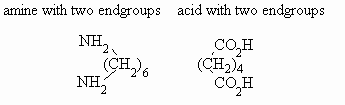 |
In the mid-1930's, Carothers (a chemist working with DuPont in the US) worked out that if this could be done with a diprotic acid (an acid with two acid groups) and a dibasic amine (a molecule with two amine units), then the process would keep happening: a polymer would form.
The result is nylon:
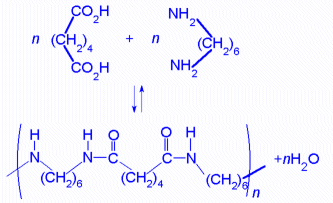 The reaction used to form nylon 66 |
This product, "Nylon 66", is used as fibre (shirts, dresses), and as a "plastic", e.g. chopping boards, bicycle wheels, ...
A laboratory experiment to illustrate this is the nylon rope trick (this is usually done as a demonstration for safety).
 A setup of the nylon rope trick. The reaction occurs at the interface, forming a thread of nylon molecules that can be reeled off onto a spindle. |
Note to teachers: The reaction described above uses 1,1,1-trichloroethane as the solvent for the sebacoyl chloride (not dichloromethane as used in days gone by). In this case, 1,1,1-trichloroethane is denser than water so it forms the bottom layer. Experimental notes will be available soon.
This reaction actually uses the acid chloride (a far more reactive species) rather than the acid, so that the reaction goes to completion at room temperature (equilibrium issues are considered later):
 Synthesising nylon 66 using sebacoyl chloride and 1,6-hexadiamine. |
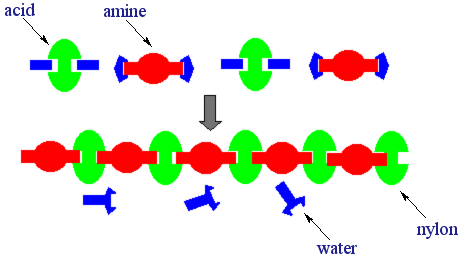
The coupling through the elimination of water is like sticking bits of a model together after punching out the connecting pieces.
 |
 |
 |
 |